

When my ADHD son started primary school, doing homework quickly became one of our daily struggles. In the last two years, we have been using the same homework system. From crying over homework in 1st grade, my now, 3rd grader, does his homework independently (most days). I’ve compiled all the visuals and system we used in the very beginning. If you don’t have a homework routine yet. I recommend that you start with this starter pack:

FREE Homework Success Starter Pack
Struggling with homework battles?
Download our free Homework Success Starter Pack with checklists, routines, reward charts, and simple systems that helped our family reduce stress and support independence.
For many ADHD kids, homework isn’t just an academic task. It’s a chain of executive function skills happening all at once: planning, organizing, remembering assignments, estimating time, getting started, staying focused, checking work, and packing everything away again afterward.
My son has become proficient with the homework routine above. Hence, we’ve decided to introduce a new skill: recording his details of his homework.
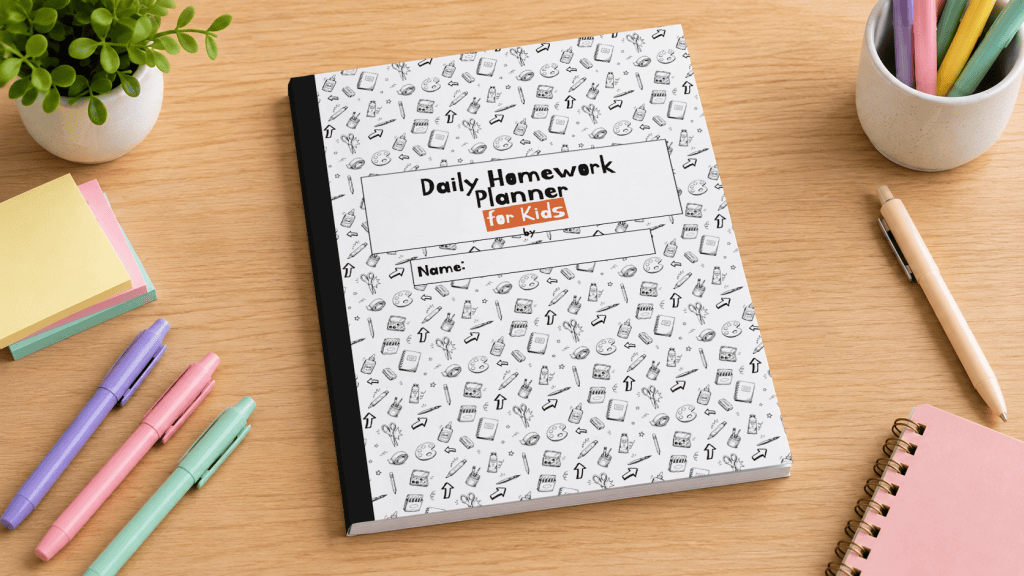
That’s why we created this Study Planner Toolkit.
This toolkit was designed to help build confidence, reduce homework battles, and slowly support the skills that lead toward independence.

Step 1: Introducing the Homework Routine
For younger children, especially Grade 1 students, the weekly planner works best when completed together at first. In our experience, my ADHD son started becoming proficient with using this system around the third month of using it consistently. It wasn’t just him who was learning what to do. We were also figuring out how best to support him during that period – giving him snacks, recognizing fatigue or frustration before it fully escalates and providing more support. We’ve summarized the common problems and listed some solutions and turned it into a chart:

We recommend sitting down during the weekend and filling out the weekly planner together before the school week starts. Write down homework, projects, spelling tests, reading logs, or anything else coming up for the week.
The Weekly Planner also becomes the place where stars are recorded.
Checking it daily helps children begin connecting:
- assignments,
- routines,
- responsibilities,
- and rewards. (In our experience, my son mainly used it to track how many stars he earned so he can get his reward.)
For many ADHD kids, keeping everything “inside their brain” simply doesn’t work consistently yet. External systems help reduce that mental load.
Read my 11 Homework Strategies we use with our ADHD son for more helpful homework tips!
1. The 4-Step Homework Routine & Brain Check Stations Guide
One thing we learned quickly as parents is that vague instructions don’t help much.
“Go do your homework” sounds simple to adults. But many children need the exact process broken down into visible steps.
Our homework routine uses four simple steps:
- Take out everything you need
- Persevere (check the Brain Check Stations if stuck)
- Slow down and check answers
- Pack it away
That’s it.
The Brain Check Stations are there to help children recognize common “stuck” moments and problem-solve through them.
Maybe they:
- don’t know where to begin,
- feel overwhelmed,
- forgot instructions,
- got distracted,
- made a mistake and shut down,
- or simply ran out of mental energy.
Having visual reminders nearby helps them reset faster without the situation escalating into a full blown meltdown.
We also highly recommend preparing a designated homework shelf, box, or station where children can easily find:
- their schoolbag
- pencils,
- erasers,
- sharpeners,
- rulers,
- headphones,
- calculators,
- or other commonly needed supplies.
Tiny delays can easily become giant distractions for ADHD brains.
2. The Star System
The Star System adds motivation while children are still learning the routine.
Children can earn:
- 5, 4, 3, 2, or 1 stars depending on how independently they complete the process.
Extra stars can also be earned for:
- starting homework calmly,
- using the Brain Check Stations to get “unstuck,”
- and staying focused.
Immediate rewards tend to work better than distant rewards for many ADHD children. One episode of a favorite show, extra game time, or a small privilege after homework often works far better than “maybe something at the end of the month.”
With our ADHD son, we gave two types of rewards:
- Immediate reward = This is most effective for ADHD brains. We give our son game time for 30 minutes right after finishing homework + an extra 10 minutes for showering independently. We have a step-by-step shower routine guide for him.
- Long-term reward = He can earn 10 stars and exchange it with a pack of Pokemon cards or delay and wait until he earns 30 stars and exchange it with a small toy (recently it was monster trucks). We’re hoping to build his ability for delayed gratification.
Step 2: Building Daily Homework Independence
As children become more comfortable with the routine, support can gradually decrease while responsibility increases.
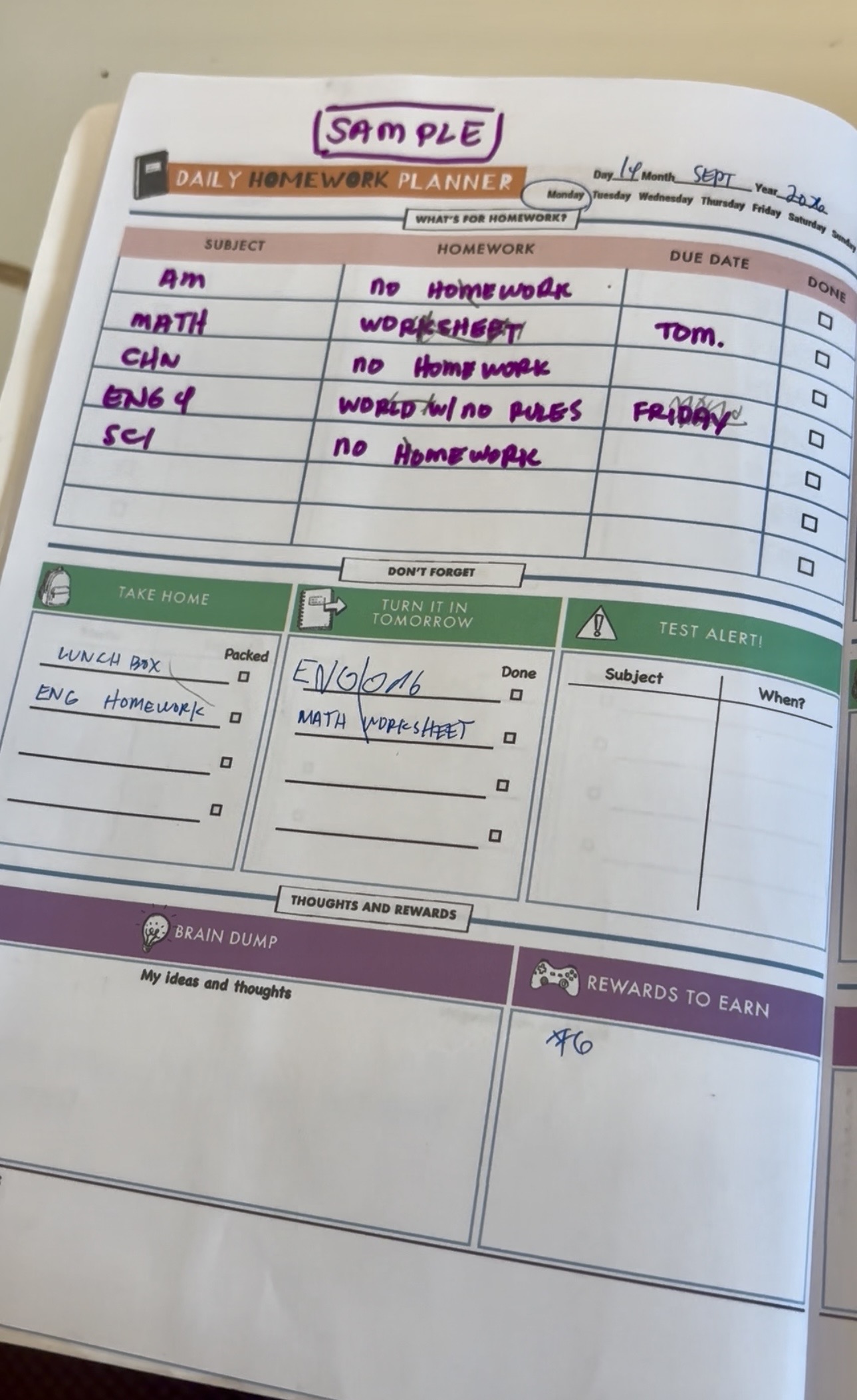
This is when the Daily Planner becomes more important. My son is currently at this stage.
The Daily Planner helps children:
- record assignments,
- track tests and projects,
- remember what needs to go home or back to school,
- and build organization skills.
One small habit that helps a lot: writing down the subjects needed for the next day the night before. This means he doesn’t have to think about it tomorrow.
To build the habit of recording, I told my son to write “no homework” for subjects that don’t require anything.
During this stage, parents shift into more of a coaching role:
- reviewing the planner together,
- helping prioritize tasks,
- asking guiding questions,
- and supporting organization when needed.
We will also stop rewarding stars for things our son can already do very well.
Instead of earning stars for completing the 4-step routine itself, children can begin earning stars for independence skills like:
- recording assignments independently,
- bringing home materials,
- using the Brain Check Stations without prompting,
- completing homework with fewer reminders,
- and packing their bag for the next day.
You can refer to the star chart we use in the toolkit. However, every child’s struggles look different, which is why the toolkit also includes a blank star chart for families to customize their own goals.
Step 3: Expanding Planning Skills
Once daily homework routines become more manageable, children can begin learning larger planning skills.
The Monthly Planner helps track:
- school events,
- projects,
- sports,
- appointments,
- and family activities.
The Yearly Planner can be completed at the start of the school year or New Year to help families:
- mark important dates,
- prepare for busy seasons,
- set goals,
- and practice long-term planning habits.
We will continue to share our own progress with building independence!
If this blog has helped you, be sure to check out our Study Planner here:

Morning Routine + Shower Routine + Study Planner Bundle:






Leave a Reply